
Dec 6th 2020
How to Properly Measure Leaf Spring Size for Your Vehicle
How to Properly Measure Leaf Spring Size for Your Vehicle

On roads and highways across the United States, various types of vehicles carry heavy loads that often maximize the weight capacities of the cars, vans and trucks in question. Therefore, vehicles need all the gravity absorption they can master.
In many types of vehicles, and especially larger ones, quality leaf springs are necessary for gravity absorption and to prevent suspension sag. This is particularly vital in pickup trucks, where rear axles can often get weighed down with heavy items, such as furniture and moving boxes.
While a robust suspension system is expected to last, over time, it loses its strength and you'll need a replacement. Understanding how to measure vehicle leaf springs to identify the correct part and ensure optimal suspension performance is essential.
Understanding Parts of a Leaf Spring
Breaking down leaf spring structure gives you a clearer picture of the components that require measuring. Explore the key parts below.
Springs
The springs are the long metal strips that serve as the operative pieces of the whole component. They are stacked in an inverted pyramid with the longest on top. Collectively, the springs form an inverted arch that is held in place by a center bolt.
Additionally, the springs are bound together at the quarter-lengths with clips. On some top springs, the ends curl upward to form enclosed circles, which are referred to as "eyes." Most leaf springs consist of three, four or five leaves, but they can go even higher than that, depending on the capacity needed. In short, springs consist of the following pieces and characteristics:
- Metal strips (usually three, four or five)
- Inverted pyramid stack
- Inverted arch shape
Bottom Spring
Below the stacked set of arched springs is a horizontal strip known as the bottom spring, which is a shorter, thicker flat leaf that serves as a rebound spring for the other springs. The bottom spring is known as the overload spring, but since it doesn't add to the gravity absorption, it could be more accurately thought of as a rebound spring. On most leaf springs, there's only one bottom spring, though some models consist of two.
Center Bolt
At or near the center of the top spring is a vertical bolt that holds everything together. While the bolt is usually located directly at the center, some top springs will measure longer on one side than the other. The bolt connects all the springs in the stack that comprises the arch, as well as one or more flat springs at the bottom.
When measuring the length of a given set of leaf springs, you use the bolt as the starting point. The center bolt is known for the following characteristics:
- A vertical bolt near the center of the springs
- Holds the top and bottom springs together
- The starting point when measuring leaf springs
End Tips
On most leaf springs, the end tips are also known as the eyes because of the enclosed, curled shape. On some leaf springs, the arch simply comes to an end with no curl at the tip — these are known as slipper springs. On most leaf springs, the tips are identical, whether it's an eye or slipper. However, some sets have both types of ends, such as an eye at the front tip and a slipper at the back.
How to Measure Leaf Spring Size
There's a simple process you can follow to record correct measurements. Here is a step-by-step breakdown:
- Length: When measuring the length, record two separate measurements starting from the center of each eye or slipper to the center bolt. This way, you provide both the length and the location of the center bolt on the spring, as they are not usually in the dead center.
- Width: A leaf spring's width is measured by the distance from one edge to the other along the top spring. On most leaf springs, the width is between 2.5 inches and 3.0 inches. Whereas the length of leaf springs correlates to the measurements of a vehicle's rear-axle suspension, the width is an indicator of the shock absorption needs of a given vehicle.
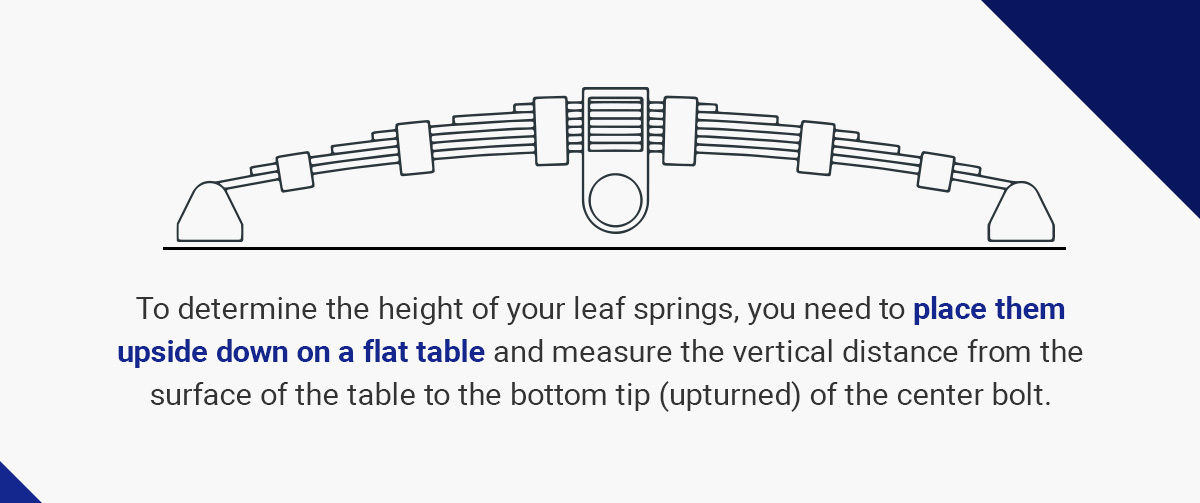
- Height: You can determine the height of a leaf spring by the thickness of the springs from top to bottom, as well as the space that fills the arch. Therefore, height is determined by more than just the measurements of the center bolt. To determine the height of your leaf springs, you need to place them upside down on a flat table and measure the vertical distance from the surface of the table to the bottom tip (upturned) of the center bolt.
- Thickness: Once you've measured the length, width and height of a leaf spring, it's time to take the thickness of each spring into account. Do this by running a tape measure vertically down the edge of the top spring. A measurement of individual spring thickness won't add to what you already know about the overall height of a leaf spring set, but it will let you know the preferred thickness of springs for the gravity absorption of a given vehicle.
Leaf Spring Configurations to Consider
Here are leaf spring configurations to consider when taking measurements:
Eye-to-Eye
To measure the length of a top spring with eyes at both ends, start your tape measure at the center bolt and extend the ruler tape against the surface until it reaches the center of the front eye. While measuring the leaf spring, follow the arch with the ruler. Take the measurements and repeat the process, this time measuring the distance along the spring surface from the center bolt to the center of the back eye. Combine the two measurements into one, and you'll have the length of the longest leaf spring.
In some cases, the two half measurements are even, which confirms that the bolt is situated at the center of the set as a whole. With other leaf springs, however, there could be a disparity of as much as five inches between the two half measurements, which would indicate that the top spring extends further in one direction.
Eye-to-Slipper
Measuring the length of an eye-to-slipper spring follows the same process as the traditional eye-to-eye top spring. You record the length on either side of the center bolt, extending the tape measure along the surface of the spring to the center of the eye and then to the tip of the slipper.
Camel-Back
Measuring truck leaf springs is slightly different on Mack trucks because the springs come in a unique design known as camel-back. The name reflects the upturned leaves that mimic the shape of a camel's hump with the smallest leaf at the top and the lack of a flat leaf.
Another distinguishing characteristic is the placement of the longest leaf, which is second from the bottom and is therefore not the outermost leaf in the set. The longest leaf is sandwiched by two leaves of matching length. It's the length of those two second-longest leaves that you want to measure, starting from the center bolt and extending outward in both directions.
Single-Point
Single-point springs are a category of trailer leaf springs designed to support the entire weight of a cargo on a center tube beam or pivot, similar to a seesaw. The leaf springs for this heavy-duty suspension system are slightly upturned. You can measure the length of the bottom leaf, starting from the center bolt in each direction.
How to Check Leaf Springs
Leaf springs are critical components contributing to your vehicle's performance and ability to carry loads. Paying attention to failing leaf springs is crucial, as that means the failure of your suspension system. Keep an eye out for these signs of leaf spring damage:
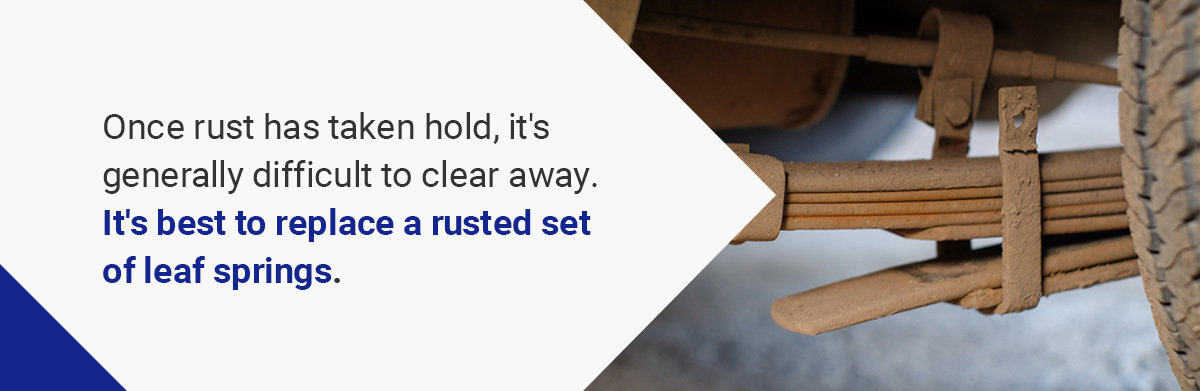
- Corrosion: The biggest enemy to nearly all forms of metal is rust, which can spread over the surfaces of metal objects and ultimately eat right through. Once rust has taken hold, it's generally difficult to clear away. It's best to replace a rusted set of leaf springs.
- Cracks: The most obvious sign of leaf spring damage that necessitates immediate replacement is when cracks appear on the leaves. Often, the end result of rust and cracks is outright leaf spring failure, leaving your rear suspension at risk, especially if your vehicle carries heavy loads.
- Leaning: If your vehicle seems to lean to one side, it's an indicator that a newly-installed leaf spring is ill-matched or that one spring has given out. Leaf springs need to be compatible on both sides for even distribution of rear-end gravity suspension. On older vehicles, it's generally best to replace both leaf springs at once, even if only one of the leaf springs has shown noticeable signs of wear.
- Suspension sag: Monitor the performance of the rear suspension on your vehicle. Does your truck sag in the back when loaded? If your headlights are pointing upward and your seat feels like a rocking chair, chances are your leaf springs are failing to provide sufficient gravity absorption. Does your vehicle sway heavily when you drive over speed bumps? This shouldn't happen if your rear axles are equipped with high-quality leaf springs.
Why Trust General Spring KC?
For 60 years, General Spring has served DIY enthusiasts and professionals nationwide, becoming a trusted authority in automotive suspension. Our commitment to quality, innovation and customer satisfaction is evident in an extensive inventory of leaf springs and other suspension components tailored to the unique needs of each of our customers.
We offer unparalleled service by working with manufacturers who are committed to high quality standards. We custom-make leaf springs to match your exact needs. Are you looking for a heavy-duty upgrade or planning a restoration project? You can rely on our trusted insight, like thousands of our happy customers, knowing that our expert team is dedicated to helping you find the perfect suspension solution.

Get New Leaf Springs From General Spring KC
With our detailed tips for measuring leaf springs, you will be able to record accurate measurements and get the correct part for your vehicle.
At General Spring KC, we carry leaf springs of various sizes, thicknesses and vehicle models, ranging from Ford, Chevy, Nissan, Freightliner and so on. Browse our broad leaf spring inventory to order your new parts, or contact us for further inquiries.